

Chemical Printing and Dyeing Membrane Filter Press Services for High-Performance Filtration
2026-09-20
Most dyehouse managers learn the hard way that a standard filter press doesn't survive aggressive printing pastes and dye-laden wastewater. Membrane filter press services promise better cake dryness and shorter cycles—but only when the equipment and support align with your chemistry. In the chemical printing and dyeing industry, high-performance filtration isn't optional. Sinou has carved out a reputation by tackling these exact challenges, from reactive dye sludge to pigment wash water. In this post, we dig into what actually moves the needle: membrane squeeze pressure, cloth selection, and service responsiveness. If your current setup is eating into margins, you'll want to read on.
Membrane Technology That Handles Aggressive Dye Chemistry
Dye synthesis and textile dyeing generate streams that are not just colored but chemically hostile—think hot caustic soda, concentrated salt, residual oxidizers, and pH swings. Standard polymeric membranes turn brittle or lose flux within hours under such conditions. The membranes used here are built from sulfonated polyethersulfone, PVDF blends, or ceramic oxides that shrug off aggressive dye baths without swelling or cracking.
A tight nanofiltration or ultrafiltration layer is tailored to retain dye molecules in the 300–1000 Dalton range while letting monovalent salts pass through. This makes it practical to desalt reactive dyes, recover indigo from rinse water, or concentrate sulfur dyes without generating a secondary sludge. Surface charge is tuned to repel anionic dye aggregates, which keeps the permeate clean and lowers the osmotic penalty.
Fouling from hydrophobic dye particles and oligomers is the real test. Antifouling coatings and periodic reverse pulse cleaning restore flux without aggressive solvents. Operators can run longer campaigns between CIP cycles, even when the feed swings from acid red to alkaline navy. The result is a membrane system that stays predictable where conventional treatment turns into a maintenance nightmare.
Custom Filter Press Design for High-Solid Slurries
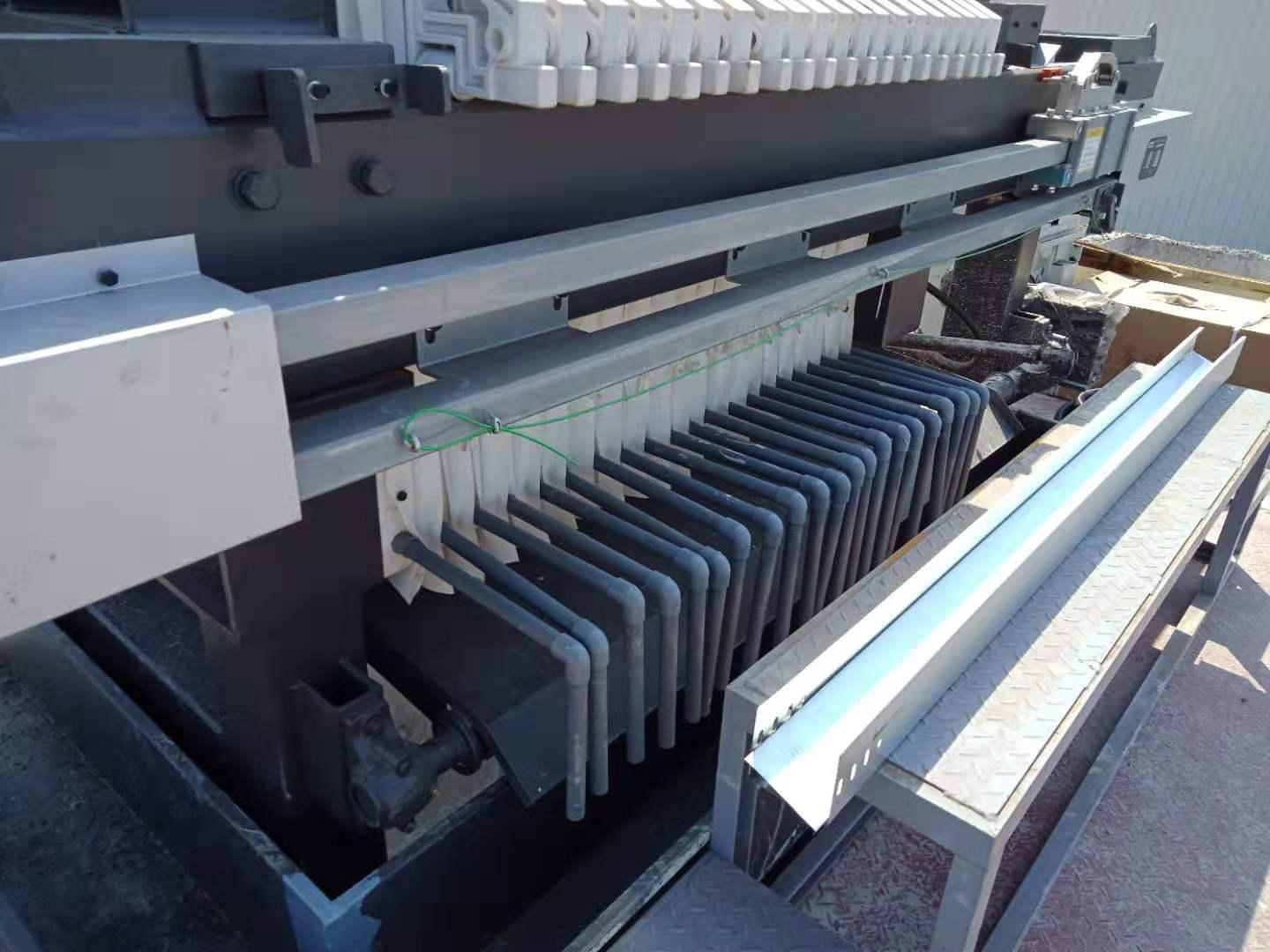
Handling high-solid slurries often exposes the limits of standard filter press configurations. Rather than forcing a generic frame size or plate stack onto a thick, abrasive feed, custom designs start with the slurry's rheology, particle size distribution, and dewatering target. Adjusting chamber depth, feed port geometry, and plate material prevents premature blinding and uneven cake build-up. In many cases, a variable volume design with deeper chambers and wider filtrate channels delivers more consistent cycle times than simply increasing pump pressure.
Beyond plate geometry, the hydraulic closing system and core blow-down sequence play a larger role when solids content climbs above twenty percent. Custom designs often incorporate dedicated core blow manifolds, membrane squeeze options, and automated cloth wash cycles that are sized for the actual cake thickness, not a theoretical average. Material choice for plates and manifolds also shifts—polypropylene may work for fine chemical slurries, while high-solid mining tailings call for reinforced polypropylene or cast ductile iron with replaceable wear liners.
The real advantage of a custom press appears at the discharge end. With high-solid feeds, filter cakes tend to be denser and less cohesive, so a custom design may include a plate shifter with controlled vibration, a larger cake drop zone, or even a downstream cake breaker integrated with the press frame. These details cut manual intervention and keep cycle times predictable, which often matters more than raw filtration area when the slurry itself is the bottleneck.
Remote Monitoring to Prevent Unplanned Downtime
A vibration sensor on a critical pump picks up a subtle change long before it becomes a bearing failure. Remote monitoring systems pull in that data around the clock, compare it against the asset's own history, and flag only the deviations that matter. That gives maintenance teams a chance to schedule a repair during a slow shift instead of scrambling after a midnight breakdown.
Instead of relying on walkaround inspections every few days, the system watches temperature, pressure, and current draw continuously. When a compressor starts running hotter than its usual range for that time of day, the alert goes to the person who can act. This kind of early warning often means replacing a seal or cleaning a filter rather than rebuilding a motor.
Over time, the collected data also reveals patterns that routine checklists miss. A recurring spike on one line every Tuesday at 2 a.m. might trace back to a specific load or a software sequence. Addressing that root cause turns remote monitoring from a simple alarm into a tool for making downtime less and less likely.
Reducing Water Usage Through Efficient Cake Washing
Efficient cake washing can cut water consumption significantly by shifting from fixed-volume rinses to conductivity- or turbidity-triggered endpoints. Instead of washing for a preset time, operators monitor the breakthrough curve of dissolved impurities and stop once the target purity is reached. This simple change often reduces wash water use by 20–40% without affecting product quality.
Another practical lever is staged countercurrent washing. Rather than sending fresh water into every wash cycle, the effluent from the final rinse is reused as the feed for an earlier rinse. Combined with better distribution of wash liquid across the cake surface—through low-impact spray nozzles or improved plenum design—this approach avoids channeling and dry spots that force extra rinses. For many filtration processes, such adjustments deliver the same cake purity with a substantially smaller water footprint.
Compliance-Ready Filtration for Strict Discharge Limits
Instead of bolting on compliance measures after the fact, these filtration units are engineered from the ground up to operate well inside regulatory thresholds. Real-time sensors track turbidity, TSS, and residual chemicals, while the control logic automatically adjusts backwash cycles and chemical dosing to keep effluent quality stable—even when influent loads spike.
The core treatment train combines depth filtration with an optional membrane polishing stage, capable of removing particles down to 0.1 microns. This redundancy means that even if one layer underperforms, the discharge still stays far below permitted limits. No single point of failure can push you out of compliance.
For operators, the system generates automated compliance logs that align with common permit reporting formats. Pre-set alarm thresholds and remote diagnostics cut down on manual sampling trips, freeing your team to focus on other tasks while staying audit-ready at all times.
From Pilot Testing to Full-Scale Implementation
Moving beyond the initial pilot often reveals just how much of the early success depended on a handful of motivated people rather than the process itself. The transition to full-scale implementation starts with a clear-eyed review of what actually broke, what was quietly worked around, and which assumptions no longer hold when the number of users multiplies. Instead of simply expanding the pilot, a more reliable approach is to redesign the workflow around the constraints that surfaced, tightening the handoffs and removing steps that only made sense at a smaller scale.
Full-scale rollout also shifts the focus from proving a concept to sustaining consistent results across different teams, locations, and levels of experience. That means building in stronger feedback loops, setting realistic thresholds for when to intervene, and accepting that some local variation is not a flaw but a necessary part of adoption. The teams that handle this transition well tend to treat the first few months of full operation as a second learning phase, not as the finish line, adjusting training, support, and metrics as evidence accumulates rather than waiting for a perfect launch.
FAQ
Membrane plates can squeeze the cake after filtration, lowering moisture content and reducing disposal volume, which matters a lot when pigment sludge is sticky and high in COD.
It depends on temperature, pH, and solvents. For most dyehouse effluent we start with polypropylene membranes, but if aromatic solvents or strong oxidizers are present we switch to EPDM or NBR blends.
We suggest visual inspection every 400–600 cycles and a full plate teardown every 2,000 cycles or once a year, whichever comes first. Frequent acid washes for dye scale accelerate wear, so adjust based on wash logs.
Yes, in many cases. We check frame depth, hydraulic pressure, and manifold layout first. Retrofitting often gives a 15–20% drop in cake moisture without replacing the whole press.
Most jobs run 90–150 minutes including feed, membrane squeeze, core blow, and cake discharge. Highly hydrophilic reactive dye sludge sits at the longer end unless we add a pre-coat or conditioning step.
We use a combination of mono-filament cloths with a tighter weave, scheduled high-pressure washing, and sometimes an acid or enzyme soak. For starch-based pastes, enzyme cleaning every two weeks works well.
Usually 12–16 bar for polypropylene membranes. Going above 16 bar rarely improves dryness enough to justify the extra wear, unless the cake is very fine and compressible.
Conclusion
For textile dyehouses and pigment operations, standard filter presses quickly degrade when exposed to reactive, acid, or solvent-based dye baths. Our membrane filter press services step in with polypropylene or PVDF membrane plates, chemically resistant seals, and automated squeeze cycles that maintain cake dryness even as dye chemistry shifts between batches. Rather than forcing a generic frame into a demanding slurry, each press is configured around the actual solids loading, particle size distribution, and viscosity of your printing and dyeing waste stream. High-solid slurries, often exceeding 30% solids by weight, receive wider chamber depths, reinforced plate packs, and a feed manifold designed to distribute slurry evenly without blinding cloths.
Remote monitoring adds a layer of operational security: pressure transducers, filtrate turbidity sensors, and hydraulic oil temperature logs stream to a dashboard that flags anomalies before a plate pack failure or cloth tear shuts down the line. When cake washing matters for water recovery, our counter-current wash sequence and membrane squeeze reduce rinse water consumption by up to 40% compared to conventional recessed chambers. Effluent from the press meets tight municipal or zero-liquid-discharge limits because filtrate clarity and heavy metal capture are verified through sampling ports and inline meters. The same engineering team that runs bench-scale filtration trials at your facility then scales the design to full production, handling dye intermediates, indigo vat residues, or pigment dispersions without interrupting dyeing schedules.
Contact Us
Contact Person: HaiYan
Email: [email protected]
Tel/WhatsApp: +86 18957325588
Website: https://www.senyoubeton.com/