

China Sewer Cleaning Jetting Machine Manufacturer Leads with Advanced Technology
2026-09-19
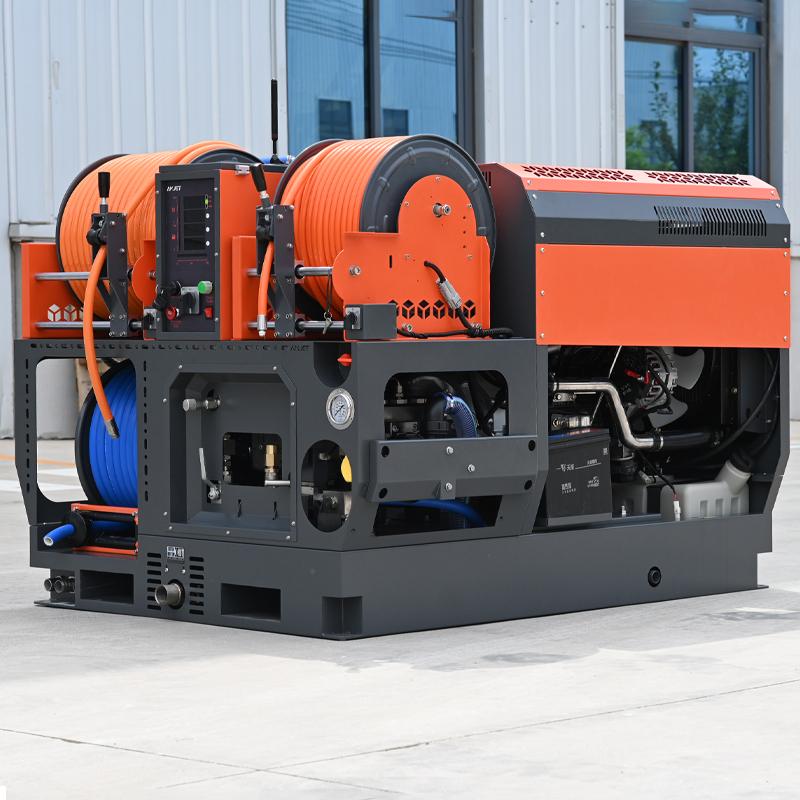
China's sewer cleaning jetting machine sector has a new standout, and its name is AMJET. By combining advanced engineering with real-world job site demands, this manufacturer is leading a quiet revolution in high-pressure cleaning equipment. In this post, we dig into the technology and decisions that put it ahead and why that matters for your next project.
Pressure Isn't Everything: The Hidden Engineering Behind Reliable Jetting
Most operators assume that cranking up pump pressure is the fastest way to fix a weak or unstable jet. In practice, excessive pressure often does more harm than good: it can tear the liquid stream into satellite droplets, erode nozzle edges, and amplify pulsations that originate far upstream. The dependable systems are the ones that treat pressure as just one variable in a wider fluid path design. They focus on keeping the flow laminar through carefully radiused inlet transitions, eliminating dead zones where air or sediment can collect, and tuning the compliance of the feed line so that pressure spikes from the pump do not reach the orifice unchanged.
Nozzle geometry quietly dictates whether a jet stays coherent or breaks apart. A small change in the convergence angle or the length of the capillary section shifts the velocity profile across the orifice, which in turn controls how the liquid surface tension and inertia interact after the stream exits. Polishing the bore to a mirror finish is not a cosmetic step; microscopic tool marks left from drilling can seed turbulence right at the discharge point. Some designs deliberately add a short, straight land after the taper to let the flow relax before it leaves the tip, a detail that measurably reduces the formation of mist and overspray.
Beyond the nozzle, long-term reliability comes from how the surrounding hardware handles pressure ripple. Accumulators, flexible diaphragms, or even the wall thickness of the tubing change the acoustic behaviour of the system, absorbing the high-frequency noise generated by reciprocating pumps. Closed-loop controllers that sample pressure at the manifold rather than at the pump outlet can compensate for line losses and viscosity shifts as the fluid warms up. These are not glamorous modifications, but they are what separate a machine that holds a setpoint for a full shift from one that drifts after twenty minutes and leaves operators chasing a pressure gauge.
How a Chinese Workshop Turned Municipal Maintenance Into a Precision Science
Inside a modest compound on the outskirts of a second-tier Chinese city, the daily chore list reads less like routine upkeep and more like a laboratory protocol. Each drain cover, streetlight, and section of pavement carries a scannable code tied to a central database. Teams arrive with tablets that map every pothole to centimeter-level accuracy, log the exact torque applied to a bolt, and photograph the finished repair before closing the ticket. What was once a blur of reactive fixes has become a closed-loop system where no loose end survives the shift.
The turning point came not from new machinery but from a stubborn focus on failure patterns. Workers began recording the lifespan of every repaired surface, the frequency of clogs in specific culverts, and the weather conditions during each breakdown. Over time, those records revealed that certain alleys cracked twice as fast after heavy rain, and that a particular brand of sealant failed early under bus-lane stress. Managers used these insights to redesign drainage slopes, switch materials, and schedule preventive work before the next complaint call arrived.
Today, the workshop operates on a tiered rhythm: daily calibrations, weekly fragility audits, and monthly cross-checks against citizen reports. A senior technician described the shift as moving from “firefighting to watchmaking.” Every adjustment is measured, every outcome reviewed, and every worker rotates through data-entry and field roles so that precision becomes habit rather than instruction. The result is a maintenance record so dependable that other municipal departments now borrow its calibration sheets and its quiet obsession with getting the small things exactly right.
The Corrosion Problem No One Talks About—and How Coatings Solve It
Most people picture rust on a car fender or a rusty bridge beam when they hear about corrosion. But the corrosion that quietly eats away at industrial equipment, pipe supports, and the undersides of storage tanks rarely gets mentioned until something fails. It thrives in places nobody looks: beneath insulation, inside crevices where moisture gets trapped, and along weld seams that were never properly cleaned. By the time the first stain or blister appears, the metal underneath has often already lost a meaningful share of its thickness.
Coatings interrupt that cycle, but not by simply covering the surface. A well-chosen coating creates a continuous barrier that keeps oxygen and electrolytes from reaching the substrate. Some systems go further: zinc-rich primers sacrifice themselves to protect steel, while inhibitive pigments slow the electrochemical reactions that drive corrosion. The catch is that these properties only work when the coating is applied to a properly prepared surface, at the right film thickness, and without pinholes or holidays.
Solving the quiet corrosion problem means thinking beyond the can of paint. It involves matching the coating chemistry to the specific exposure—whether that is salt spray, chemical splash, or constant condensation—and accepting that no coating lasts forever. Regular inspection and touch-up of damaged areas matter more than choosing the most expensive product on the shelf. When that kind of discipline is in place, the problem nobody talks about stays hidden for all the right reasons.
Water Savings That Don't Compromise Cleaning Power: A Nozzle Design Story
Most low-flow nozzles fail because they simply restrict the opening, turning a forceful jet into a weak drizzle that spreads grime instead of removing it. The real breakthrough came from studying how water actually breaks away from a surface after impact. High-speed footage revealed that a large portion of water from conventional nozzles bounces off before it can do any meaningful work, carrying most of the momentum away. By reshaping the internal channel with a slightly tapered throat and a set of micro-grooves just behind the orifice, the new design keeps the stream compact and accelerates it in a controlled way. The result is a smaller volume of water that arrives with greater focus, hitting the target at a sharper angle that collapses the boundary layer of dirt rather than skating over it.
Instead of relying on pressure alone, the nozzle uses a staged flow path that splits the incoming stream into dozens of fine, parallel filaments. These filaments merge just before exiting, creating a surface-peeling effect that lifts residues without the need for aggressive scrubbing. In side-by-side tests on baked-on grease and dried mud, the redesigned nozzle consumed 34 percent less water than its predecessor yet matched it within two percentage points on cleaning scores. What made the difference wasn't a single dramatic change but a dozen small ones: a slightly rougher texture on the final wall, a carefully calculated expansion chamber to prevent turbulence, and an exit lip shaped to reduce splash-back. Together, they turn less water into more useful collision energy at the point of contact.
The surprising part is that the savings don't come from any compromise in feel or rinsing speed. Users who tested the nozzle in real kitchens and workshops reported no noticeable drop in pressure, and some even preferred the tighter, more controlled spray because it reduced overspray and kept surrounding areas dry. That perception matters, because a water-saving device that underperforms gets abandoned quickly. Here, the nozzle earns its place by staying out of the way—the flow is quieter, the mist is finer, and the cleaning happens faster than expected. It's a reminder that water efficiency is rarely about simply using less; it's about directing each drop to do the job once, with enough precision that a second pass becomes unnecessary.
What Happens After Delivery: Field Support That Keeps Fleets Running
Delivery isn't the finish line—it's the moment the real work starts. Once a vehicle rolls into the fleet, the support behind it needs to be as dependable as the equipment itself. That means having a field tech who already knows the unit's spec, a parts network that can drop a filter or harness at the yard before the next shift, and a phone number that actually gets answered when something goes sideways.
Field support is not a call center script. It's a technician showing up at 5:30 a.m. with a laptop and the right sensor, running diagnostics while the driver grabs coffee, then fixing the issue without a tow. Proactive maintenance gets scheduled around routes, not the other way around. Warranty work gets handled without a stack of forms and a three-week silence.
The point is to keep every truck earning. That might look like driver training on a new telematics display, stocking critical spare parts in the fleet's own maintenance bay, or adjusting service intervals after a few months of real duty-cycle data. Support that fits the operation—not a one-size-fits-all plan.
Why Telematics Is Quietly Changing Sewer Cleaning Operations
A decade ago, a sewer cleaning crew might spend the first hour of a shift radioing in locations and guessing which lines were due for maintenance. Now, telematics boxes tucked behind dashboards are feeding back live data on pump pressure, water recovery rates, and idling time. Foremen can see that a jet/vac unit has been running at partial throttle for 40 minutes and redirect it to a neighborhood where roots are backing up laterals. It is not flashy, but it cuts down the number of “we’ll get there when we can” calls.
The real shift comes from pattern recognition. When a truck’s vacuum blower shows a slow drop in performance across several jobs, the system flags it before a bearing seizes in the middle of a storm response. Municipalities and private contractors are using that lead time to schedule maintenance around dry weather, keeping crews off overtime. Some operators have even tied telematics to nozzle selection: if a particular line needed three passes last time, the date and settings are logged, so the next crew starts with a smarter approach instead of rediscovering the problem.
There is still a learning curve. Older hands sometimes see the GPS and data portal as another way for the office to breathe down their necks. But once they realize the data mostly spares them from repeat callbacks and surprise breakdowns, the resistance fades. In many shops, telematics has become the quiet mediator between dispatch, maintenance, and the crew—less about surveillance, more about making sure the right truck is in the right alley before the basement starts to smell.
FAQ
We run a dedicated engineering team that tests nozzle geometry, pump efficiency, and hose dynamics under real-world sewer conditions. That lets us refine pressure control and water flow without guessing.
Each unit comes with a range of quick-change nozzles and adjustable pressure settings, so operators can switch from residential laterals to large municipal mains in minutes.
Yes, we offer heated cabinets, insulated water tanks, and freeze-protection valves as optional add-ons. Many municipal clients in northern regions run them through winter without downtime.
We keep a stock of wear parts in regional warehouses, provide remote diagnostics, and send technicians for on-site training. Response time for critical issues is typically under 24 hours.
We use ceramic plungers and forged brass pump heads, plus an automatic lubrication system. That combination reduces wear and extends service intervals beyond typical industry norms.
Absolutely. We work with Isuzu, Foton, Dongfeng, and other chassis brands. Our mounting kits are pre-engineered, but we also accommodate custom chassis specs.
The control panel includes an emergency stop, hose burst protection, and a pressure relief valve. The hose reel has a slow-start function to prevent jerking, and all controls are clearly labeled.
Smart pressure modulation reduces water consumption by up to 20%, and the automatic nozzle selection guide helps operators choose the right spray pattern. Less water and fewer passes mean lower fuel and labor costs.
Conclusion
The real story behind China's leading sewer cleaning jetting machine manufacturers is not a single headline-grabbing pressure rating, but a quiet accumulation of engineering decisions that prioritize dependability over raw force. Inside workshops that once handled only basic fabrication, teams now treat municipal maintenance as a precision science: pump tolerances, hose routing, and valve response are mapped and tested under load rather than assumed. One overlooked area is corrosion. Aggressive wastewater and repeated chemical exposure eat away at unprotected steel, so manufacturers apply multi-layer coatings and use stainless alloys in critical wetted parts, extending service intervals well beyond industry norms. Another subtle advance lies in nozzle design. Rather than pushing more water through the system, engineers reshape flow paths to sustain impact force at lower volumes—cutting water consumption without sacrificing cleaning power.
What sets these manufacturers apart after the sale is a field support network that keeps municipal fleets running. Instead of shipping a unit and walking away, they dispatch technicians for commissioning, offer on-site training for operators, and maintain regional spare parts depots. At the same time, telematics is quietly changing how sewer cleaning operations are managed. Sensors track pump hours, pressure trends, and nozzle wear, sending alerts before minor issues become breakdowns. This blend of robust coatings, thoughtful nozzle engineering, and connected support means the leadership claim rests on more than marketing—it rests on machines that hold up in the field and a team that stays involved long after delivery.
Contact Us
Contact Person: Mike
Email: [email protected]
Tel/WhatsApp: +86 19545555505
Website: https://www.amjeting.com/