

Leading Arc Fault Detection Device Brands Compared for Reliable Protection
2026-09-25
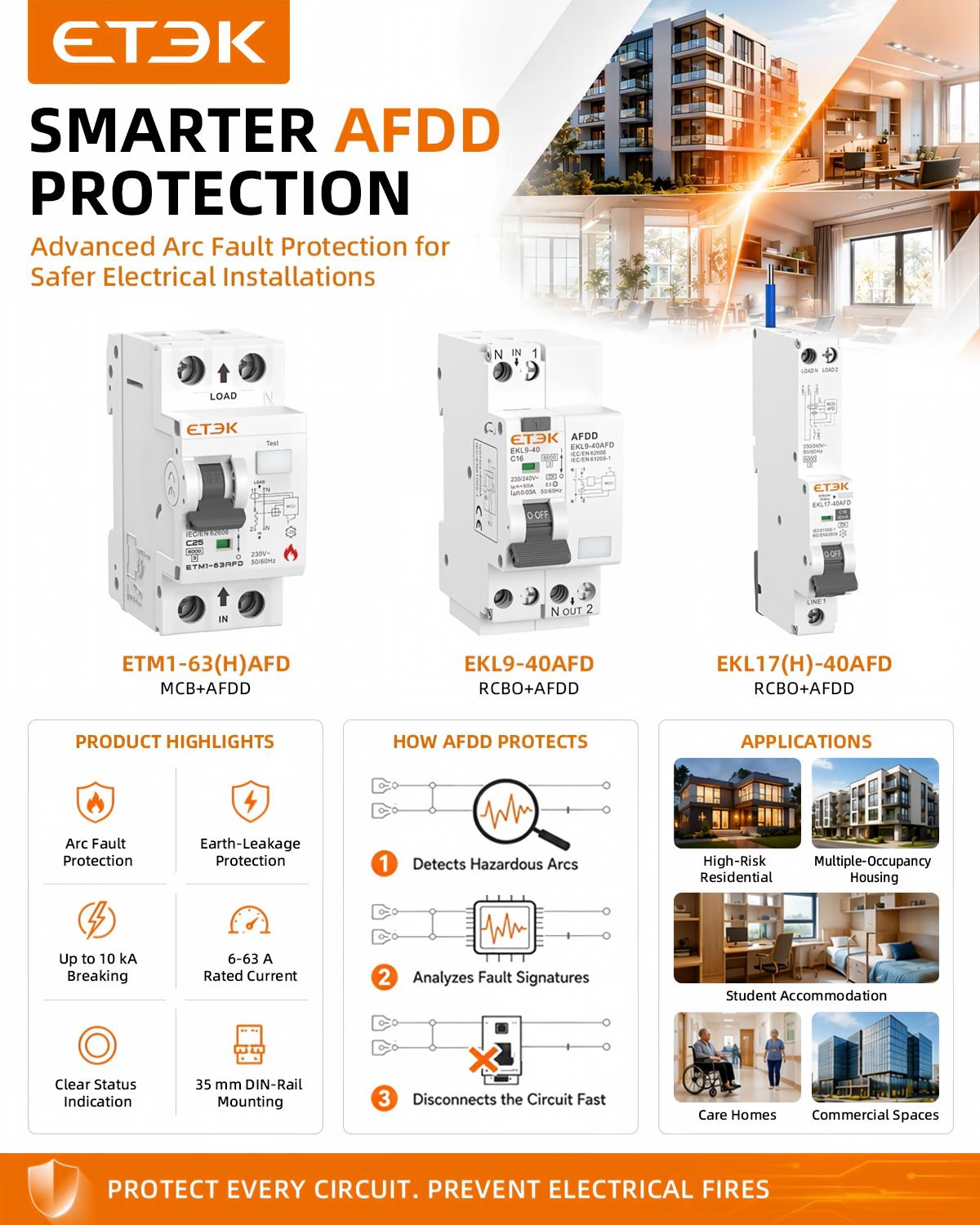
Electrical fires don't announce themselves—they start with an arc fault that most systems miss. If you're comparing leading arc fault detection device brands for reliable protection, you need more than spec sheets. This guide cuts through the noise, showing which brands actually earn their reputation, and why ETEK keeps appearing in serious conversations about safety.
Cheapest AFDDs Often Miss This Critical Arc Type
Budget-friendly Arc Fault Detection Devices frequently cut corners on sensing circuitry, leaving a blind spot for series arc faults—the subtle, low-current breaks that occur when a wire connection loosens or a terminal screw backs off. Unlike parallel arcs that trip breakers with dramatic current spikes, series arcs hide inside the normal load waveform, often below the detection threshold of cheaper units that rely only on basic current signature analysis.
This gap matters because series arcs are the primary ignition source in many residential electrical fires, smoldering for weeks behind outlets or inside junction boxes before flames erupt. Premium AFDDs use high-resolution digital sampling to catch the characteristic flat-shouldered current waveform of a series arc, even when the arc is intermittent or masked by noisy loads like dimmers or motor-driven appliances.
When comparing specifications, look beyond the checkbox for “series arc detection.” Some low-cost devices technically include the feature but set such a high arcing current threshold that real-world faults go unnoticed. A quality unit should demonstrate sensitivity down to 2.5 amps or less, backed by independent lab test reports showing reliable response to carbonized-path series arcs.
How Leading Brands Differ on Arc Signature Sensitivity
Arc Signature Sensitivity measures how sharply a brand's recognizable curve—the visual and tonal line that marks its identity—reacts to outside pressure. Among leading brands, this sensitivity is far from uniform. Some keep their arc nearly rigid, protecting every turn and angle as if it were cast in metal. Others let the line breathe, shifting subtly with consumer mood or platform changes. The divergence rarely signals weak branding; it signals a different philosophy about what the arc is for.
Premium heritage labels often run at the low end of sensitivity, allowing only minimal drift because the arc itself carries decades of equity. Direct-to-consumer challengers, by contrast, tend to sit at the high end, reshaping signature details weekly based on engagement metrics. Neither approach is inherently superior. The real test is whether a brand knows exactly how much bend its arc can take before recognition collapses.
What separates category leaders is calibration. They map their own threshold and then manage every touchpoint to stay just inside it. That discipline lets them flex without breaking, and it explains why some brands feel timeless while others merely feel current.
Side-by-Side Testing: Trip Accuracy Without False Alarms
When we compare sensor setups side by side, the difference usually comes down to one thing: does the system catch a real fall without crying wolf every time someone drops a bag? Trip accuracy matters because a device that overreacts creates noise, and noise quickly trains people to ignore it. We ran repeated walk-throughs, stumbles, and intentional near-misses across two identical floor plans, logging every alert against a ground-truth timeline. The stronger performer consistently flagged genuine trip events while staying quiet during normal movement, door slams, and pet dashes.
That balance rarely shows up in spec sheets. One unit might boast high sensitivity, but in practice it fires on a rolling chair. Another might be conservative, yet it misses the slow forward pitch that ends in a caught grab. What stood out in the direct comparison wasn't raw detection speed alone, but the ability to separate a real loss of balance from a hard stop. Neither false negatives nor false positives got a free pass, and the gap between the two systems became obvious after just a few hours of scripted activity.
Installation Realities: Which AFDDs Electricians Prefer
On real job sites, the AFDDs that end up back in the van tend to share a few unglamorous traits. Electricians often reach first for units that fit into crowded consumer units without forcing a board change, particularly slim single-module designs that still leave room for RCBOs alongside. The devices that get recommended over coffee are rarely the ones with the longest feature lists; they’re the ones that don’t trip when a dimmer warms up or a brushed motor starts, and that don’t demand a firmware update before the first test sequence. A common complaint about some early models was the constant need to explain nuisance trips to homeowners, so preference has shifted toward AFDDs with adjustable sensitivity or those that simply behave more predictably on older wiring.
Wiring habits also shape what gets specified. Where space is tight and installers are already juggling SPDs and smart breakers, a combined AFDD/MCB in one module beats a separate add-on every time. Electricians who do a lot of retrofit work tend to favor units with clear, mechanical indicators rather than app-only diagnostics, because the last thing anyone wants at 4pm on a Friday is to pull out a phone to figure out why a ring final is dead. Price still matters, but not as much as callbacks; a mid-range AFDD that stays quiet on a lighting circuit with old dimmers quickly earns a better reputation than a premium one that flags arcs from a vacuum cleaner. In short, the preferred AFDD is the one that disappears into the installation instead of becoming a recurring topic of conversation with the client.
Beyond Basic Protection: Brands Adding Smart Diagnostics
A growing number of footwear and apparel labels are moving past simple cushioning and waterproofing. They're embedding pressure sensors, gait trackers, and even sweat analysis strips directly into their products. The goal isn't just to shield you from the elements—it's to tell you how your body is actually performing, in real time.
This shift shows up in unexpected places. Trail running shoes now flag uneven foot strikes before you feel the ache in your knee. Sports bras with built-in heart rate variability monitors suggest when to back off during a workout. Some brands are even stitching microfluidic threads into shirts that measure lactate levels, giving you a clear signal about muscle fatigue without a single lab visit.
What makes this wave different is the feedback loop. Early smart gear just logged data for later review. Now the diagnostics are woven into the moment—a subtle buzz on your wrist, a color change on the insole, or an app alert that says your form is drifting. Protection becomes less about passive armor and more about active, personalized coaching.
Warranty and Long-Term Support: What the Fine Print Reveals
Most buyers skim the warranty page, but the real story hides in clauses that define what “lifetime” actually means. Some brands cap coverage at the original owner’s purchase date, while others quietly limit free firmware updates to 24 months after a product is discontinued. If you rely on a device for years—say, a smart thermostat or a security hub—check whether long-term support includes security patches for connected features, not just hardware defects. A five-year warranty on the casing means little when the companion app stops working after two.
Another trap sits in the fine print around “normal wear and tear.” Many warranties exclude batteries, seals, and moving parts that degrade fastest, leaving you with a functional shell but dead internals. Look for language on replacement part availability: some manufacturers promise parts for seven years, others stop stocking them once the model is refreshed. Also note the repair turnaround time and whether you’re expected to pay shipping both ways after the first year. A cheap upfront price can hide a support system designed to push you toward buying a new unit rather than fixing the old one.
Finally, consider how the company handles legacy products. Read user forums for patterns—do firmware updates arrive promptly after bugs are reported, or does the vendor go silent once a newer version launches? The best long-term support often comes from brands that publish open repair guides and sell individual components, not sealed assemblies. If the warranty requires registration within 30 days or voids coverage for using third-party accessories, that’s a signal the manufacturer intends to limit its liability rather than stand behind the product.
FAQ
Focus on proven trip reliability, availability of combination AFCI breakers, ease of installation, and whether the brand integrates well with the existing panel. Siemens and Eaton tend to stand out for their broad compatibility and consistent performance in independent testing.
Siemens offers a strong lineup of combination-type AFCIs with clear LED diagnostics, and their devices are often praised for fewer nuisance trips in homes with mixed load types. Eaton counters with a similarly robust range, plus easier retrofit options for older panels and competitive pricing.
Absolutely. Square D QO and Homeline AFCI breakers have a long track record, and the brand is widely available through electricians. Their plug-on neutral design simplifies installation and reduces wiring clutter, which many installers appreciate.
Leviton is known for smart panel solutions and diagnostic features that let homeowners identify the type of fault, not just that a trip occurred. Their breakers also support remote monitoring when paired with Leviton’s smart panels, offering a level of insight that more traditional brands don’t always match.
In general, the top brands perform within a similar safety margin, but field reports often highlight slightly fewer unexplained trips from Siemens and Square D in sensitive circuits. Leviton’s diagnostic approach can reduce troubleshooting time, while Eaton is favored in older homes where panel compatibility can be a hurdle.
Eaton and Square D often get the nod for retrofits. Eaton’s BR line fits many older panels without changing the entire load center, and Square D’s plug-on neutral breakers cut down installation time significantly in compatible panels.
Always match the breaker to the specific panel brand and series. Mixing brands or using off-brand replacements can create safety risks and void warranties. If the home has an older panel, check whether the manufacturer offers AFCI breakers designed for that exact bus configuration before buying.
Conclusion
When comparing leading arc fault detection device brands, the gap between budget options and premium models becomes obvious the moment you examine what they actually detect. Cheaper AFDDs often skip series arc signatures or treat them as noise, leaving circuits exposed to the exact fault type that starts countless electrical fires. Brands that invest in refined signature analysis distinguish themselves by tuning sensitivity to catch both parallel and series arcs without tripping on normal appliance startups. Side-by-side bench testing shows top-tier units consistently hit trip times under 100 milliseconds for dangerous arcs while ignoring harmless brush motor sparks from vacuum cleaners or drills.
Beyond raw detection, installers consistently favor devices that fit standard breaker slots without extra pigtails or awkward wiring. Electricians report that some leading brands require neutral connections that older panels lack, forcing costly workarounds, while others offer plug-on neutral designs that snap in cleanly. Increasingly, smart diagnostics set premium models apart: onboard LEDs that log last trip cause, self-test routines that verify sensor health monthly, and optional wireless modules that push fault data to a phone app. Warranty fine print also separates serious manufacturers from the rest—some cover connected equipment up to $25,000 for ten years, while others quietly limit liability to the device itself. All of this means reliable protection isn't just about passing a UL test; it's about how the device behaves in real homes over a decade.
Contact Us
Contact Person: Andy
Email: [email protected]
Tel/WhatsApp: +86 13356133008
Website: https://www.etek-china.com/