

OEM 2 Ply Engraving Plastic in China: Your Guide to Premium Custom Engraving Materials
2026-09-22
Looking for a 2 ply engraving plastic that actually holds up to your laser’s precision and your client’s expectations? China’s OEM scene is packed with options, but most fall short on consistency, color depth, or custom sizing. That’s where LYSHIRE changes the game. In this guide, you’ll discover what separates premium engraving stock from the rest—and how to source it without the usual guesswork.
Why Two-Ply Engraving Plastic Delivers Cleaner Cuts Than Solid Sheets
Two-ply engraving plastic isn't just a material choice—it's a different way of thinking about the cut itself. The top layer, typically a thin cap of contrasting color, acts as a built-in depth guide. When the laser or rotary bit hits that second layer, you get an immediate visual cue: the underlying core shows through, and the edge stays crisp because the cap material is sliced cleanly away rather than melted or dragged. Solid sheets, by comparison, force you to rely on guesswork for depth and often leave a slightly ragged lip along the cut line, especially on detailed lettering.
There's also a mechanical advantage that rarely gets mentioned. The bond between the cap and core isn't perfectly rigid—it has a tiny amount of give. That microscopic flex absorbs a portion of the cutting vibration and heat, reducing the chance of burrs or micro-cracks along the vector edges. With a solid acrylic or HDPE sheet, all that energy goes straight into the material, so you're more likely to see chatter marks or a slightly melted bead on curves. The result with two-ply is a cut that feels almost pre-finished, even straight off the machine.
And for anyone doing high-volume engraving, the difference shows up in consistency. Because the color break tells you exactly when to stop, you can run a batch of fifty badges with the same settings and get the same clean line every time. Solid sheets demand constant fiddling with focus and speed, and even then, one sheet might cut beautifully while the next leaves a fuzzy edge. Two-ply removes that variable, which is why sign shops and trophy makers keep coming back to it for fine text and small graphics.
Custom Color Layering: Matching Your Brand Without Pantone Guesswork
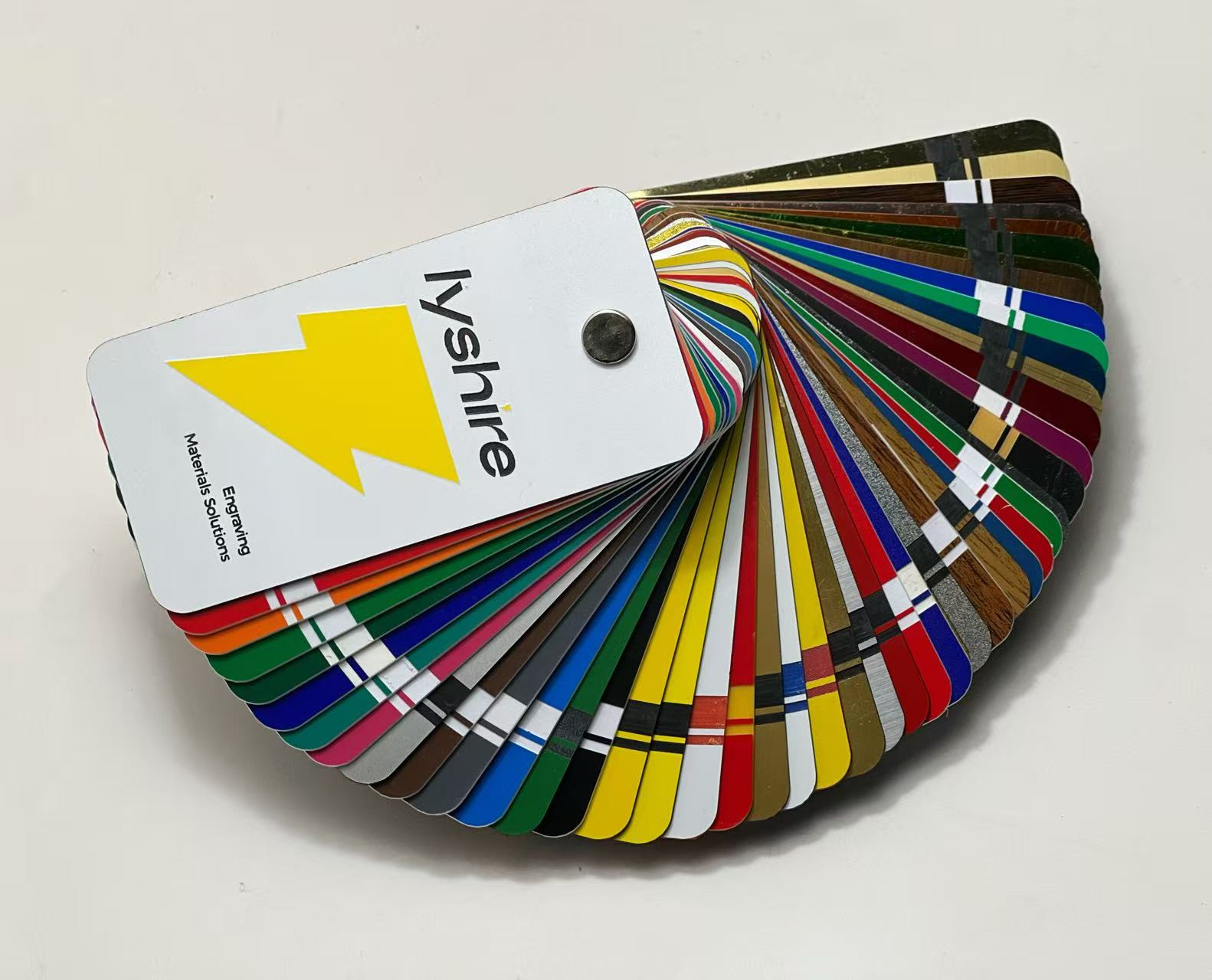
Matching brand colors can feel like a guessing game when you're working outside a standardized Pantone library. Custom color layering flips that approach: instead of chasing a single pre-mixed swatch, you build the target hue from translucent inks or toners, adjusting density and overlap until the printed result mirrors what your brand already uses on screen and in physical signage.
The real advantage shows up when a client hands you a logo with a gradient, a metallic sheen, or a color that shifts under different lighting. By layering two or three base colors at controlled percentages, you can hit that interplay without forcing an exact Pantone match that may not exist. It's a hands-on, iterative method—more like adjusting a recipe than pulling a stock sample off a shelf.
To keep results consistent, document the layer order, ink opacity, and substrate for every approved combination. That record becomes your internal reference point, so the next run doesn't start from scratch. Over time, you build a private library of layered formulas tied to actual production outcomes, not generic fan decks.
Sheet Size and Gauge Flexibility from Chinese OEM Factories
Most Chinese OEM factories don't lock you into a handful of standard sheet sizes. If you need 0.6 mm cold-rolled steel cut to 1250 mm width, or 3 mm aluminum at a non-standard length, they'll typically adjust the slitting and leveling lines without much fuss. The real difference comes down to gauge range—many shops handle 0.3 mm up to 6 mm on the same floor, though pushing beyond that usually means separate presses or laser beds.
One practical point: flexibility here isn't just about offering a long list on paper. It's about how quickly they can change coil stocks, swap tooling, and keep flatness tolerances tight when you mix thin and thick parts in one order. Some suppliers are willing to run trial batches at odd gauges before you commit, which helps a lot when prototyping enclosures or brackets.
Also worth noting is that smaller orders don't always mean worse pricing for custom sizes—many factories bundle different sheet dimensions into the same nesting program, so material waste stays low even if you're not ordering full coils. Just be clear about your tolerance requirements up front, especially for anything under 1 mm, because that's where gauge variation tends to show up.
Surface Textures That Hide Fingerprints and Reduce Glare
The right surface texture can quietly solve two common annoyances: smudges from fingertips and harsh reflections from bright lights. Instead of adding coatings or constantly wiping down surfaces, manufacturers are now etching fine patterns directly into materials like glass, metal, and plastic. These micro-textures break up the smooth plane that normally traps oils and bounces light straight back. The result is a surface that stays cleaner longer and feels more comfortable to look at.
A matte finish achieved through fine etching or bead blasting scatters incoming light across many tiny angles, so glare becomes a soft, diffused glow rather than a sharp hotspot. At the same time, the microscopic peaks and valleys reduce the contact area between skin and surface, meaning fewer visible fingerprint marks. This approach works especially well on touchscreens, appliance panels, and automotive interiors, where both visibility and cleanliness matter in daily use.
Designers can tune the texture depth and pattern to balance clarity and haze. A very shallow texture preserves enough light transmission for a display, while a deeper one offers stronger fingerprint resistance for a control knob or door handle. The key is that the surface itself does the work—no extra layers, no special cleaning routines. It is a practical way to make everyday objects feel more refined without drawing attention to the engineering behind them.
Tolerances and Flatness: What Actually Matters for Multi-Head Engravers
On a single-head engraver, a few hundredths of a millimeter across the bed rarely cause trouble. Put four, six, or eight spindles on the same gantry and those same numbers start to stack in ways that show up on the final part. The real question is not whether a surface plate would pass the bed—it's whether every spindle tip reaches the same Z height at the same XY position, under cutting load, after the machine has warmed up.
Flatness claims on a spec sheet usually refer to an unloaded bed at room temperature. That tells you almost nothing about what happens when a 30 kg fixture is bolted down or when spindle motors have been running for two hours. What matters is repeatable local flatness: the variation across the working envelope for each head, and the mismatch between adjacent heads on shared workpieces. Checking this with a dial indicator mounted in each collet, sweeping the same grid, reveals more in ten minutes than a calibration certificate ever will.
Most alignment issues on multi-head machines are corrected with shims, not with software offsets. If the gantry itself twists under rapid moves, no offset map will save you. Before chasing micron-level tolerances, run a simple multi-head scribing test on a scrap panel: mount identical tools, set the same Z zero, and scribe a large rectangle. If lines from different heads don't overlap at the corners, you're seeing the actual flatness and tolerance stack that your parts will inherit.
Packing and Shipping Practices That Prevent Corner Damage in Transit
Cardboard corners often take the hardest hits during transit, so shifting from standard void fill to structural edge protection can cut damage claims dramatically. Instead of relying on loose peanuts or crumpled paper, wrap each vulnerable corner with rigid angle boards or foam corner blocks, then secure them with strapping that holds the package's shape under compression. A common mistake is leaving the box's longest dimension unbraced—place a honeycomb panel or a folded corrugated insert along that axis to distribute shock away from the corners.
Palletization patterns matter just as much as the internal packaging. When stacking mixed cartons, stagger the layers so that no single corner aligns vertically across multiple boxes; this prevents a top-load corner from acting like a chisel on the carton below. For heavier shipments, add a sheet of plywood or thick double-wall cardboard between tiers, and run edge protectors vertically down each pallet corner before applying stretch wrap. The wrap should be tensioned enough to pull the load together, but not so tight that it bows the carton sides inward and shifts pressure onto the corners.
Finally, test your packing by simulating the worst-case drop before shipping. Drop the packed carton from waist height onto a concrete floor, aiming for the corner first. If the corner shows any crushing, the box was under-supported. Also check for voids near the corners after sealing—any empty space allows the product to slide and hammer the corner from inside. Fill those gaps with custom-cut foam or corrugated wedges, not just extra tape, since tape reinforces seams but does nothing for internal impact absorption.
FAQ
Two-ply sheets have a thin colored top layer bonded to a contrasting core. When you engrave through the top layer, the core color shows through, giving crisp, high-contrast text without needing paint filling. Acrylic requires extra steps like paint or laser marking to achieve similar readability, so 2 ply saves time and yields a durable, clean finish.
Chinese factories often run dedicated extrusion and lamination lines for engraving plastics, so they can adjust core thickness, cap color, and sheet size to fit your exact spec at lower minimums than many Western suppliers. Direct OEM relationships also let you lock in consistent colors across repeat orders rather than relying on whatever distributors happen to stock.
Thickness usually ranges from 0.5 mm up to 3.0 mm, with 1.6 mm and 2.0 mm being popular for rigid tags and signs. Classic combos include black/white, red/white, blue/white, gold/black, and silver/black. Some suppliers also offer brushed metallic caps or matte finishes, though those often carry higher minimum order quantities.
Rotary engraving with a sharp carbide cutter works well for fine detail, while CO2 laser engraving can handle larger runs but may produce slightly less tactile depth. No exotic tooling is needed; just ensure your bit has a flat bottom for clean cap removal. For laser, test power settings on a scrap piece first because different cap pigments absorb energy differently.
Request sample sheets with your exact color stack and thickness, then test engraving depth uniformity, cap adhesion, and resistance to common cleaning agents. Ask the factory about their cap-to-core bond method—thermal lamination tends to outperform adhesive films over time. Also check that sheet flatness stays consistent across the batch to avoid warping during engraving.
Many Chinese OEMs can add a clear protective film, cut sheets to custom panel dimensions, or supply pre-cut shapes like circles and rounded rectangles. Some offer UV-stable caps for outdoor use, anti-glare top layers, or fire-rated cores for signage that must meet safety codes. You can also request custom core colors if your brand uses a specific Pantone, although dye lots may vary slightly.
One common oversight is packaging during ocean freight—sheets can shift and scratch if not interleaved with protective paper and strapped properly. Another is specifying tolerance clearly: without agreed thickness and flatness tolerances, you might receive sheets that feed poorly through automated engravers. Always confirm whether the quoted price includes export packing and whether the factory performs a final trim to remove edge burrs.
Conclusion
When you're sourcing engraving stock from Chinese OEMs, the difference between a clean job and a frustrating one often comes down to the sheet itself. Two-ply acrylic-based laminates cut far more predictably than solid sheets because the cap layer shears away cleanly instead of melting or chipping at the edge. That matters when you're running multi-head machines and every pass has to look identical. Color layering is another area where a good factory earns its keep: rather than asking you to accept a generic red or blue, they can match your brand's specific hue by adjusting the core and cap combination. You're not stuck with Pantone guesswork or large minimums just to get a shade that actually fits your product line. And because these factories handle everything from thin 0.5 mm stock to thicker 3 mm panels, you can order exactly what your job requires—whether it's small tags or large signage—without paying for waste.
Surface finish is often overlooked until the first batch arrives with fingerprints all over a glossy face. Matte or micro-textured caps do more than look professional; they hide handling marks and cut down on glare under shop lights, which keeps your finished pieces readable. Flatness tolerance is another spec that separates decent material from the stuff that jams feeders or drifts during engraving. A reliable OEM will hold sheets within a tight flatness range so every blank sits dead level on the bed. Finally, how the material gets to you matters as much as how it's made. Proper interleaving, rigid corner protectors, and reinforced cartons prevent the kind of edge damage that ruins an otherwise perfect order. When these details are handled well, you spend less time sorting rejects and more time running profitable jobs.
Contact Us
Contact Person: Tina Hou
Email: [email protected]
Tel/WhatsApp: +86 17816238685
Website: https://www.lyshire.com